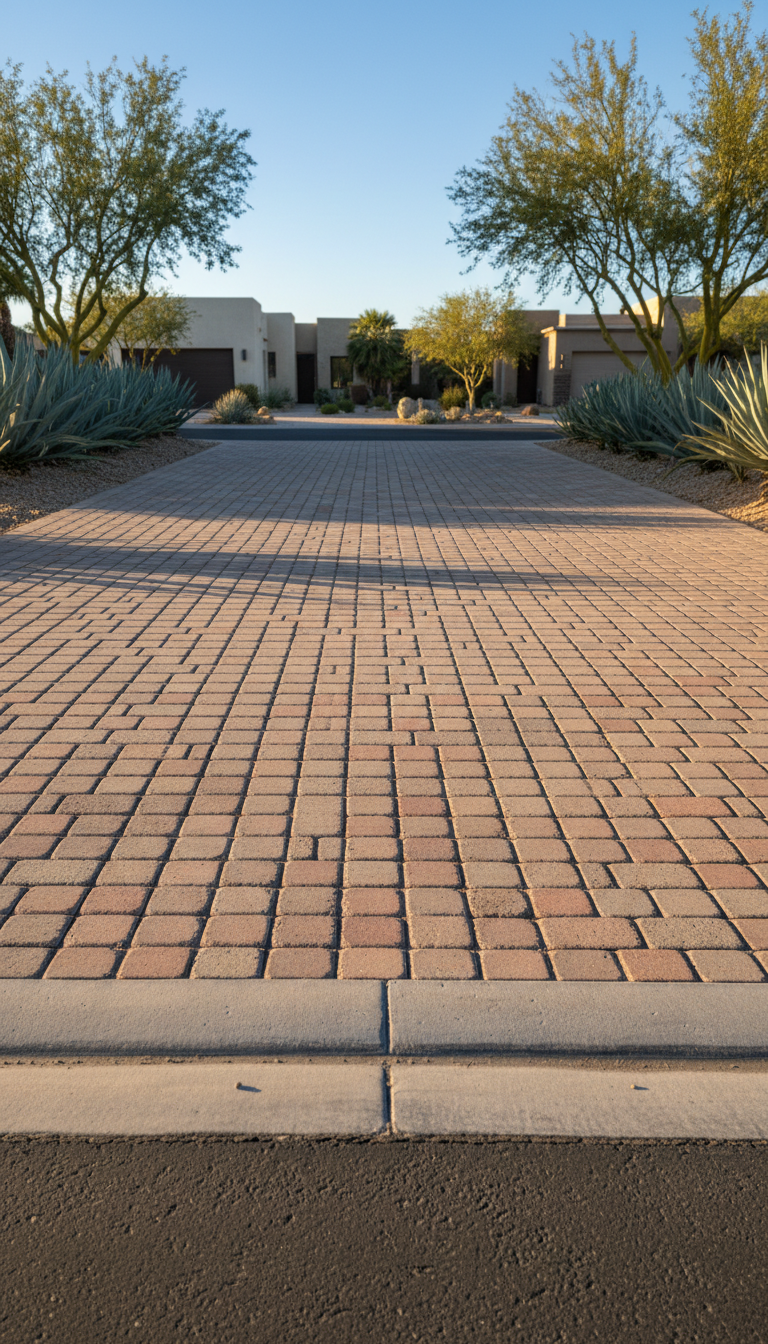
High-quality paver installation finishing details Palm Desert require meticulous subgrade stabilization and bedding sand compaction to prevent shifting caused by expansive clay soils. Utilizing heat-reflective materials like travertine and correctly applying polymeric sand creates a durable surface that withstands extreme desert temperatures while maintaining structural integrity.
You invest in high quality pavers for your Palm Desert home; however, without the right finishing techniques, even the most expensive stone can succumb to shifting soil and the intense Coachella Valley heat. It is a common frustration to see a beautiful patio lose its structure because the final technical details were neglected. At Pavers Pavers Pavers, we understand that durability is found in the precision of the finish. These final touches are what distinguish a professional installation from a project that fails within a few seasons. In this guide, we will explore the critical components that ensure longevity in our unique climate. We will cover the importance of edge restraints, the selection of joint sand designed for extreme temperatures, and the necessity of expansion joints. You will also learn about proper compaction around utilities and the best sealing practices to protect your surface while maintaining slip resistance for bare feet.
Why Finishing Details Define Longevity in the Coachella Valley
Selecting the perfect shade of silver travertine or the ideal texture for luxury stone patios is often the focus of a remodel, yet the longevity of the installation rarely depends on the surface material itself. In the Coachella Valley, the invisible technical work defines whether a surface remains pristine or becomes a tripping hazard within a few years. Palm Desert presents a brutal trifecta of environmental stressors: 120-degree summer peaks, expansive clay soil, and sudden, intense monsoon rains.
Expansive clay is particularly problematic; it swells when saturated and shrinks when dry, creating a constant cycle of subgrade movement. Without meticulous attention to the paver installation finishing details Palm Desert projects require, this soil activity leads to shifting, sinking, and lateral creep. While generic contractors might prioritize speed and surface appearance, Pavers Pavers Pavers focuses on the technical precision of the base and bond. We understand that thermal expansion and drainage management are not optional additions; they are the foundation of durability. The difference between a high-end transformation and a standard job lies in these overlooked specifics that ensure your custom paver driveways withstand the desert’s extreme thermal cycles without losing their structural integrity.
Edge Restraints: The Invisible Frame for Your Desert Patio
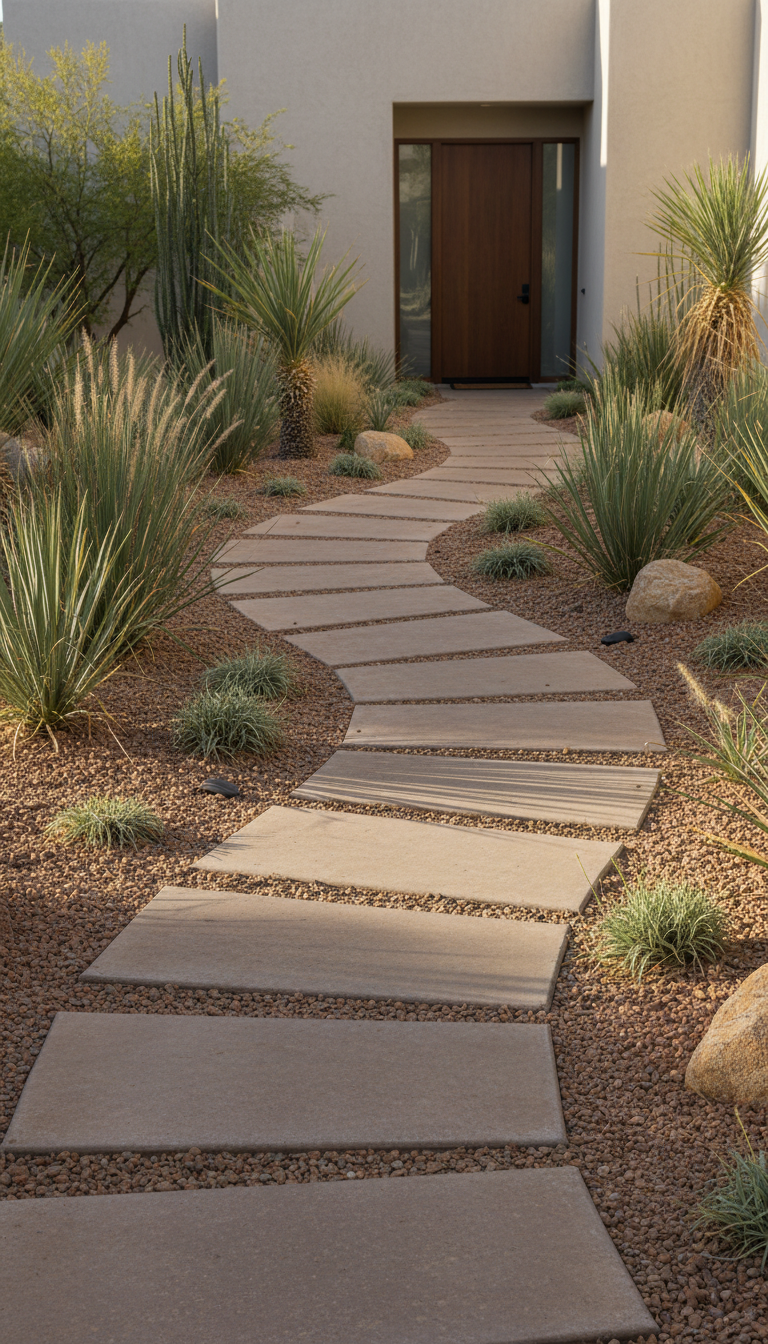
To address the common question regarding what is the best way to prevent pavers from moving, one must look specifically at the perimeter. Without a robust edge restraint system, even the most expertly laid luxury stone patios will eventually suffer from lateral creep. This phenomenon occurs when the outer pavers slowly drift outward into the surrounding desert landscaping, opening up unsightly gaps and compromising the structural interlock of the entire surface.
Restraint Type | Performance in Palm Desert | Best Application |
|---|---|---|
Plastic | Prone to warping; spikes can loosen in heat-expanded clay soil. | Short walkways or low-traffic paths. |
Metal | Durable and slim profile; requires deep anchoring to resist shifting. | Modern designs with straight, clean lines. |
Concrete Bond Beam | Superior stability; integrates with the base to resist soil movement. | Heavy-traffic driveways and premium pool decks. |
In the Coachella Valley, plastic edge restraints secured with metal spikes often fail because the intense 120-degree heat causes the soil and the plastic to expand at different rates. Over time, these spikes frequently back out of the ground, leaving the edge unsupported. For high-end custom paver driveways, we prioritize concrete bond beams. By troweling a reinforced concrete wedge along the perimeter below the finished grade, we create a submerged structural anchor that locks the pavers in place from the side and below. This method is a hallmark of the paver installation finishing details Palm Desert properties require, as it provides a rigid barrier that resists the pressure of heavy vehicles and the constant shifting of our local clay-heavy subgrade. This invisible frame ensures your investment stays exactly where it was placed, regardless of the season.
Choosing the Right Joint Sand for Palm Desert Heat
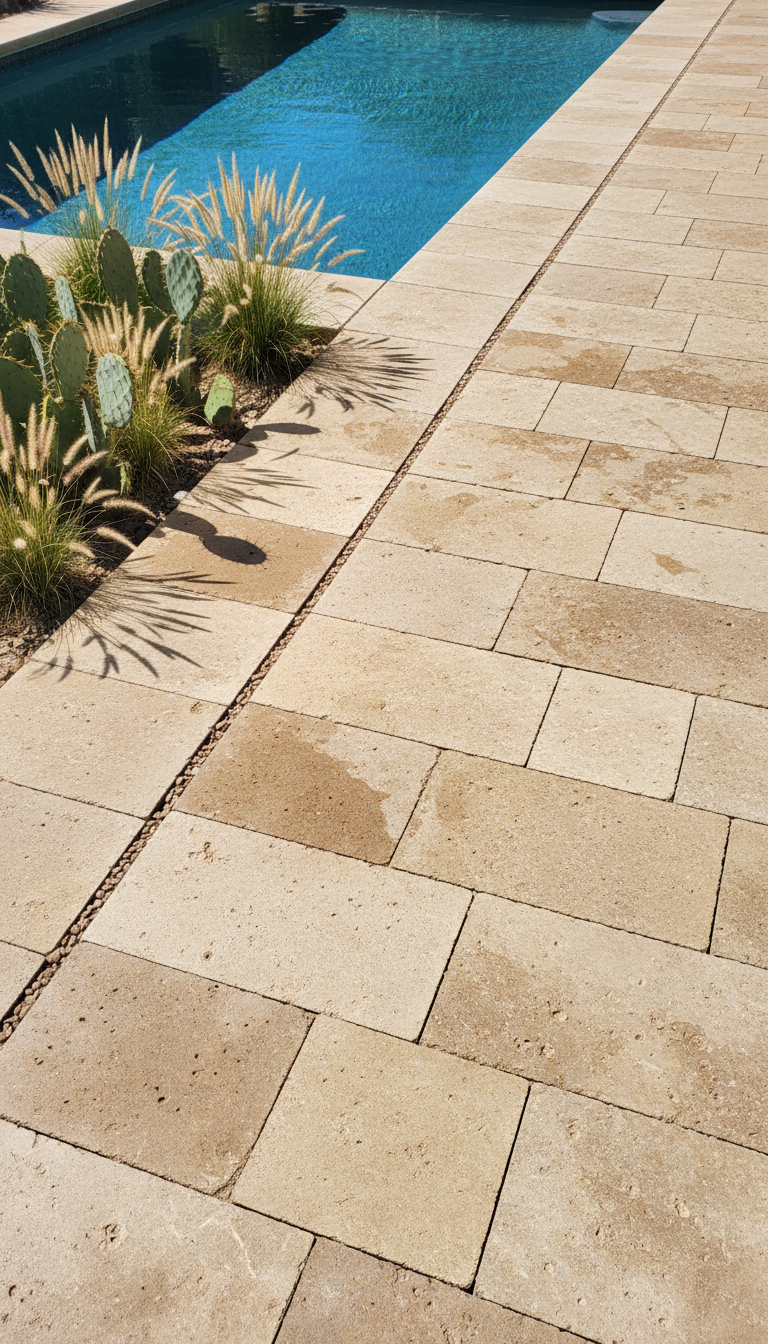
While the perimeter is secured by edge restraints, the internal stability of the system depends entirely on what fills the gaps. A common technical question homeowners ask is what kind of sand do you put between patio pavers to ensure they do not wiggle or sprout weeds. In the Coachella Valley, the answer depends on the material, the sun exposure, and the wind patterns of the specific property.
Sand Type | Characteristics | Performance in 120°F Heat |
|---|---|---|
Masonry Sand | Loose, natural silica particles. | Prone to wind erosion; attracts ants and weeds. |
Polymeric Sand | Contains additives that harden when wet. | High risk of "haze" if installed in direct sun. |
Stabilized Joint Sand | Treated with high-grade liquid binders. | Superior wind resistance; maintains thermal flexibility. |
Regular masonry sand was once the industry standard, but it often fails in our environment. Desert winds are notorious for the "blow out" effect, where fine particles are vacuumed out of the joints during a sandstorm, leaving the pavers unsupported. This is why we frequently utilize specialized joint stabilizing sand for luxury stone patios. This product provides a semi-flexible bond that holds up against wind and intense monsoon rain without the rigid, artificial texture found in lower-end polymeric options.
Polymeric sand is frequently praised for its ability to resist weeds and ants; however, it requires extreme caution during a Palm Desert summer. If the pavers are too hot during the installation process, the polymers can activate prematurely or leave a white residue, known as poly-haze, which is exceptionally difficult to remove from porous stones. Precision in the paver installation finishing details Palm Desert properties require means timing the application for the cooler morning hours and using industrial blowers to ensure no dust remains on the surface before misting. For those investing in custom paver driveways, utilizing a high-quality liquid stabilizer after a professional cleaning can provide superior protection against the elements. If your existing joints are failing, our paver cleaning and sealing services can restore the structural integrity and aesthetic of the installation.
Expansion Joints and Desert Soil Movement
Proper management of expansion joints is a critical component of the paver installation finishing details Palm Desert projects require, particularly when a flexible paver system meets a rigid structure. While pavers are naturally superior to poured concrete because they can shift without cracking, they still exert pressure as temperatures fluctuate. In the Coachella Valley, dark-colored pavers in custom paver driveways can reach surface temperatures exceeding 150 degrees. This intense thermal absorption causes the units to physically expand. Without a designated expansion joint, usually a half inch gap filled with specialized flexible sealant, the pavers can push against the home foundation or pool coping, leading to heaving or structural damage.
The behavior of local clay soil compounds this issue. As research into California subgrades indicates, clay shrinks and swells significantly based on moisture content. When the soil beneath a large installation moves, the entire field of pavers shifts as a single mass. If this mass is pinned tightly against a fixed concrete wall, the pressure has nowhere to go but up. Strategic placement of expansion joints at these transition points allows the hardscape to breathe. For luxury stone patios, these joints ensure that seasonal soil cycles do not result in uneven surfaces or cracked pool tile lines. Proper spacing at the subgrade level provides the necessary buffer for both thermal and geological movement.
The Fine Art of Leveling and Compaction Around Utilities
The technical precision of the paver installation finishing details Palm Desert experts provide is most visible where the hardscape meets essential utilities. Pool skimmers, landscape lighting, and drainage grates are necessary, but they often become eyesores or structural weak points if handled poorly. A standard installation might leave a generic plastic skimmer lid visible in the middle of a high end deck. For luxury stone patios, we prefer using color matched stone kits that allow a piece of the travertine itself to sit inside a recessed tray. This conceals the utility while maintaining full access, creating a seamless visual flow across the entire surface.
Compaction around subterranean utilities like irrigation lines and electrical conduits requires a delicate balance. If a contractor uses a heavy reversible plate compactor directly over a shallow irrigation pipe, the line will likely crack or collapse. Conversely, failing to compact that area results in localized "dishing" or sinking over time as the loose soil settles. We solve this by using hand tamping or pneumatic rammers in tight quarters, often backfilling around pipes with stabilized bedding material to distribute the load before the final mechanical compaction of the base.
Precise cuts around drain grates or light fixtures are non-negotiable for a professional finish. A poor installation is characterized by wide, uneven gaps filled with excess mortar or sand. For custom paver driveways, we use diamond blade wet saws to ensure every paver sits flush against the utility rim. This prevents the edges from catching or chipping, maintaining a smooth surface that feels intentional rather than interrupted. If your current installation shows signs of sinking around these features, professional paver cleaning and sealing services can often be the first step in identifying if the underlying base requires technical remediation.
Surface Finishing: Sealing and Slip Resistance for Bare Feet
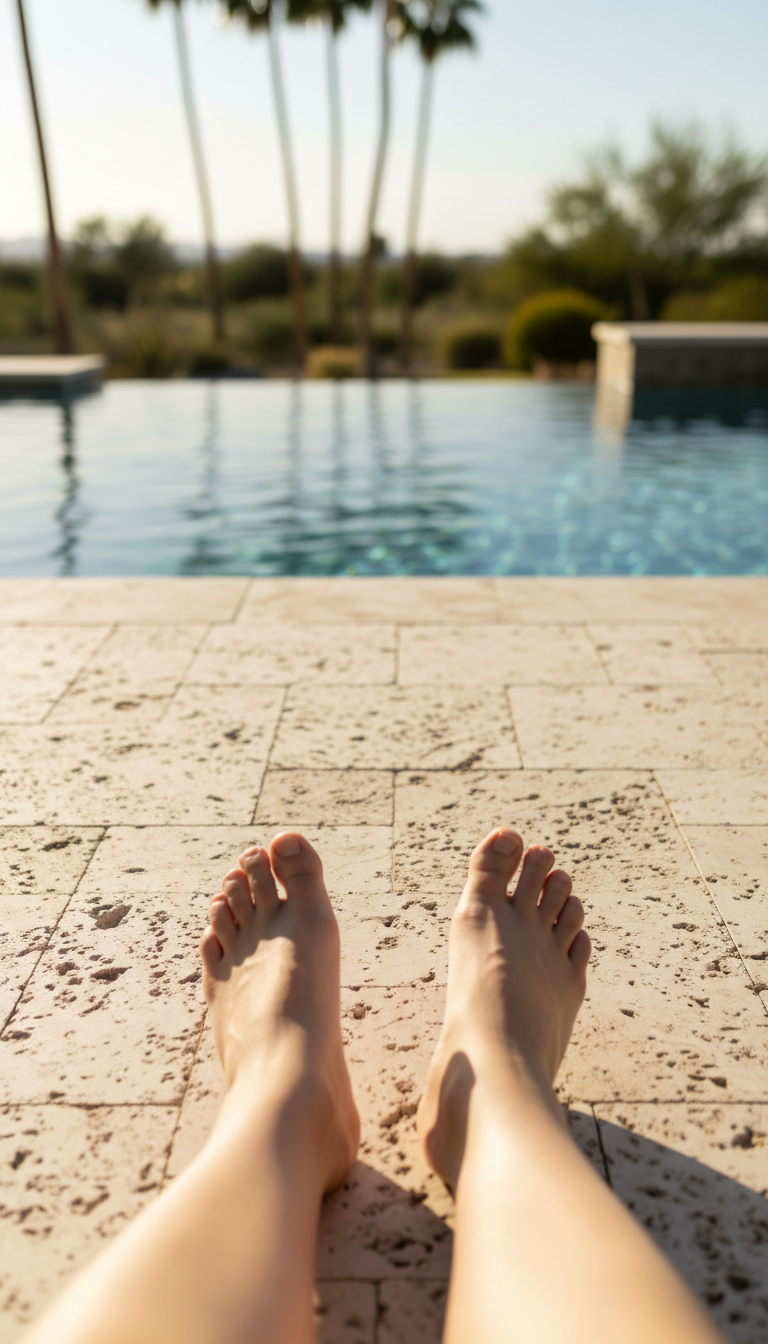
The final phase of any high-end installation involves surface treatments that balance aesthetics with safety. For luxury stone patios situated around swimming pools, the most frequent technical concern is how to make travertine less slippery without compromising its natural beauty. In the intense Palm Desert sun, the choice of sealer directly impacts both the temperature of the stone and the traction for bare feet. While natural stone is inherently a cooler material than poured concrete, applying a thick, non-breathable film can increase heat retention and create a dangerous skating-rink effect when wet.
To ensure safety, we integrate micronized polymer additives into the sealing process. These transparent, suspended granules provide a subtle, sand-like texture that increases the coefficient of friction without altering the color of the stone. Furthermore, the Coachella Valley’s specific environmental conditions require a breathable, penetrating sealer rather than a topical coating. A common failure in local hardscaping is "clouding" or "blushing," which occurs when moisture from the underlying clay soil evaporates and becomes trapped beneath a non-porous sealer, resulting in unsightly white patches.
Sealer Type | Heat Absorption | Slip Resistance | Durability in 120°F |
|
|---|---|---|---|---|
Topical Acrylic | High (Trap Heat) | Low (Slippery) | Prone to peeling and UV yellowing | |
Penetrating Silane/Siloxane | Low (Natural Feel) | High (Maintains Grit) | Superior UV and moisture resistance |
For homeowners investing in custom paver driveways, a high-quality penetrating sealer protects against oil stains and tire marking while allowing the pavers to expand and contract naturally. If your existing surface has already developed a hazy appearance or lost its traction, professional paver cleaning and sealing services are required to strip the failed product and restore the stone’s breathable profile.
Common Palm Desert Paver Finishing Mistakes to Avoid
Identifying a subpar installation early can save thousands in remediation costs. When evaluating the paver installation finishing details Palm Desert contractors provide, homeowners should look for several critical red flags that indicate a lack of technical expertise.
Improper Drainage Slope: Surfaces must be pitched at a minimum of 1 to 2 percent away from the home foundation. If water pools during a winter rain or a sudden monsoon, the saturated subgrade will eventually soften and fail.
Visible Concrete Slop: Professional concrete bond beams should be neatly troweled and hidden by soil or mulch. Exposed concrete "blobs" smeared onto the face of the pavers are a hallmark of a rushed job.
Tiny Edge Slivers: Cutting pavers into pieces thinner than two inches at the border creates structural weak points. A master installer adjusts the layout to ensure every perimeter piece is at least one third of a full unit.
Surface Clouding: Hazy white residue on luxury stone patios suggests the sealer was applied in high heat or before moisture escaped the stone.
If custom paver driveways show signs of shifting or poor jointing, professional paver cleaning and sealing services can often stabilize the surface; however, deep structural flaws like improper sloping usually require resetting the pavers to industry standards.
In summary, the longevity of your desert hardscape relies on those small but essential finishing touches that handle the intense heat and shifting sands. Mastering these details ensures your outdoor space remains beautiful and functional for years. If you would prefer to have expert help navigating these technical requirements, our team is here to support your vision. We specialize in creating durable Custom Driveways and patios tailored to the unique climate of Palm Desert. Let us handle the precision work while you enjoy the results.